Bath Linen Guide
Understanding 800 GSM: The Weight Behind Graccioza’s Plush Bath Linens
A towel’s weight can tell you a lot about its substance—but not the whole story. Here’s what 800 GSM means, how it relates to the feel of Graccioza bath linens, and why cotton, construction, and care matter just as much as the number on the label.
There is a particular pleasure in reaching for a towel that feels generous, soft, and reassuringly substantial after a bath or shower. The sensation is immediate: a fuller hand, a dense surface, a little more fabric gathered around the shoulders. Textile weight is one reason a towel can feel that way, and one figure that often appears in descriptions of premium bath linens is 800 GSM.
GSM stands for grams per square meter. It is a measure of fabric weight, not a rating of luxury, absorbency, or quality on its own. An 800 GSM towel is notably substantial compared with many everyday towels, but the number does not tell you exactly how quickly it will absorb water, how fast it will dry, or how it will feel in your bathroom. Those qualities depend on the fiber, the yarn, the loops, the finishing, and the way the towel is used and cared for.
Graccioza’s Egoist towels offer a useful example of how these elements can work together. The collection is described as 100% Egyptian Cotton GIZA ELS, with an 800 GSM construction and a high-density pile. That combination points to a towel designed to feel plush and voluminous. But understanding what the weight means—and what it cannot promise—makes it easier to assess performance in everyday life.
What GSM measures—and what it leaves out
GSM is a straightforward unit: the weight, in grams, of one square meter of textile. In practical terms, it helps describe how much material is packed into a given area. A higher GSM often corresponds to a towel that feels denser or heavier, while a lower GSM towel may feel lighter and more flexible.
That is a helpful starting point, but it is not a complete performance test. GSM does not tell you whether the towel is made from cotton, linen, or a blend. It does not specify the length or quality of the fiber, the height and arrangement of the loops, or whether a finish has changed the hand of the fabric. Two towels with the same GSM can feel noticeably different because their yarns and constructions differ.
Nor does GSM indicate how much water a towel will absorb under a particular set of conditions. A textile’s ability to take up moisture depends on factors that include fiber characteristics, surface area, yarn structure, and finishes. A dense cotton pile may offer a comforting, cushioned feel, while a more open or textured weave may allow air to move through the fabric more readily. Neither structure is automatically better for every person or setting.
Think of GSM as one useful clue in a larger description. It can help you anticipate a towel’s approximate substance, but it should be considered alongside its material and construction rather than treated as a promise that the towel will outperform all lighter alternatives.
Why 800 GSM feels substantial
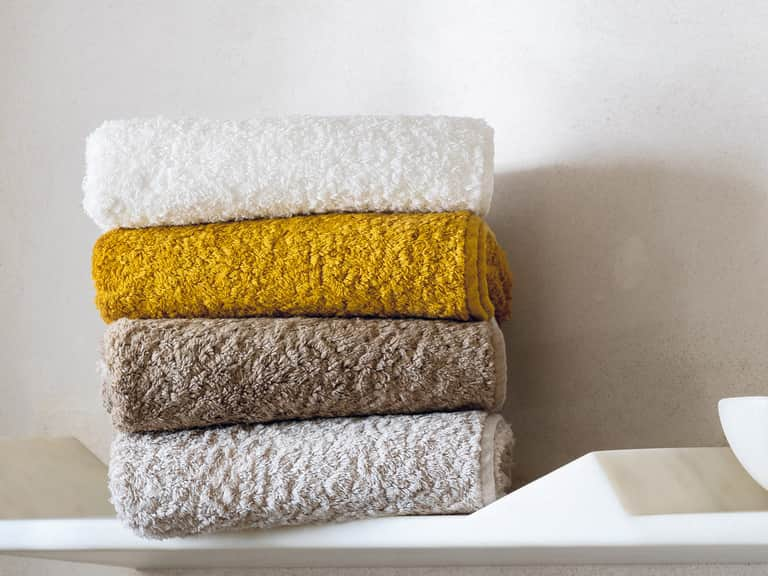
At 800 GSM, a bath towel has considerable weight for its size. That higher material density can contribute to a fuller, more enveloping sensation, especially when the towel is made with a deep, high-density pile. The surface may feel soft and cushion-like against the skin, while the added fabric gives the towel a distinct sense of heft in the hand.
Graccioza Egoist towels are described as having a “super voluminous” pile and a dense construction. Those details help explain the experience better than the weight figure alone: the GSM indicates the fabric’s mass per area, while the pile describes the loops that create the towel’s characteristic terry surface. Loops provide a large surface area for contact with moisture and give terry towels their familiar depth and softness.
Weight can also influence how a towel drapes and hangs. A heavier towel may fall with more body over a rail or hook. Its substantial feel can be especially appealing in a bathroom where a plush, spa-like hand is part of the desired experience. But heft is a preference, not a universal advantage. Someone who wants a compact towel for travel, a quick-drying option for a busy household, or a lighter feel after bathing may prefer a different construction.
The most satisfying choice is not necessarily the towel with the highest number. It is the one whose feel and practical demands suit the way you live.
The role of fiber: cotton is part of the story
Fiber content shapes the way a towel feels and performs. Graccioza Egoist towels are identified as 100% Egyptian Cotton GIZA ELS. The product information describes this as a long-staple cotton fiber. Fiber length matters because it influences the yarn that can be spun from it, and yarn characteristics in turn affect the fabric’s surface, strength, and hand.
Still, a fiber name should not be mistaken for a full guarantee of how a towel will behave. The finished textile also reflects spinning, weaving, finishing, and manufacturing choices. When evaluating bath linens, look at the complete description: fiber content, weight, pile, finishing, and care instructions together offer a more useful picture than any single specification.
In the case of the Egoist towels, the listed combination of Egyptian cotton, high density, and 800 GSM provides context for their plush character. The product information also says they are pre-washed and pre-shrunk. Pre-washing and pre-shrinking are finishing steps intended to prepare the towel for use and support dimensional stability; they are distinct from GSM and should be understood as additional features of the finished textile.
For readers comparing different towels, it helps to ask a few grounded questions: What fiber is used? Is the towel looped terry, flat woven, or another construction? Is it pre-washed? What care does the maker recommend? These details can explain why two towels with similar weights feel different once they are in hand.
Absorbency is not a number on a label
It is tempting to assume that a heavier towel must absorb more water simply because it contains more material per square meter. Weight can be relevant to the experience of using a towel, but it does not establish absorbency by itself. A towel’s moisture performance depends on the fiber and structure, as well as any treatments or residues that affect how readily water meets the fabric.
Looped terry offers a familiar example. Its raised loops create a textured surface with many points of contact, which can help the towel pick up moisture from skin. But loop height and density vary, and the character of the yarn matters too. A lofty towel and a tightly packed towel may both feel substantial yet handle moisture differently.
Graccioza describes its Egoist towels as pre-washed and pre-shrunk for absorbency and softness from the first use. That is a product-specific statement about its finishing, not evidence that GSM alone guarantees a particular result. The sensible takeaway is that weight and finishing can contribute to the experience, while the finished towel’s performance depends on the complete construction.
Absorbency is also experienced in context. The amount of water on the skin, how the towel is pressed or rubbed, and whether the towel has been washed appropriately all influence the result. A fabric that performs well after regular laundering may feel different if detergent or fabric softener has built up on the fibers. Following the care directions is a practical part of preserving the towel’s intended hand and function.
Drying time: the trade-off to consider
A plush, high-GSM towel can feel wonderful in use, but its substantial construction may take longer to dry than a lighter, more open textile. That is not a fixed rule for every towel or every home: air movement, humidity, towel placement, room temperature, and the way the towel is spread out all matter. Still, the basic trade-off is worth keeping in mind when choosing a towel for frequent daily use.
After use, a towel needs an opportunity to release moisture. A towel bunched on a hook or left folded over itself has less exposed surface than one spread across a wide rail. In a humid bathroom with limited ventilation, even a well-made towel may remain damp longer. Opening a window when appropriate, running a ventilation fan, or giving the towel more room to hang can support more effective drying.
For households where towels are used repeatedly throughout the day, a rotation can help. Having a dry towel available while another is in the wash or drying reduces pressure on any single piece. A lighter towel may suit a guest bathroom, gym bag, or warm climate; a heavier towel may be especially appealing where there is adequate airflow and the priority is a rich, enveloping feel. The question is not which weight is best in the abstract, but which is workable in your routine.
To explore the construction of the Graccioza option discussed here, see Graccioza Egoist Towels. The product details identify the 800 GSM weight, Egyptian cotton fiber, pre-washed and pre-shrunk finish, double-stitched hems, rounded corners, and sewn-in hanger.
How finishing and construction shape the experience
Specifications such as weight and fiber tell only part of a towel’s story. Construction details can influence how it feels in the hand, how it hangs, and how well its edges withstand repeated use. The Graccioza Egoist description lists rounded corners and double-stitched hems. These are practical finishing details: hems secure the cut edges, while stitching reinforces the finished boundary of the textile.
A sewn-in hanger is another everyday feature. It provides a dedicated point for hanging the towel, which can make storage more convenient and can help keep the towel accessible. But a hanger cannot substitute for adequate space and airflow. Where a towel hangs still matters, particularly if it is dense and needs more time to dry between uses.
Finishing can also influence the initial hand of a towel. The Egoist towels are described as pre-washed and pre-shrunk, with the maker associating those processes with softness and absorbency. Other products may use different processes or make different claims. When comparing labels, distinguish measurable details—such as the stated 800 GSM weight—from descriptions of touch, like “plush” or “soft.” Both are useful, but they answer different questions.
The broader lesson is simple: a towel is a system of choices. Fiber, yarn, pile, density, finishing, hems, and hanging details come together in the object you use every day. A well-informed selection considers the whole textile, not one headline specification.
Caring for a heavier bath towel
Good care begins with the maker’s instructions. For Graccioza Egoist towels, the listed directions say not to bleach or dry clean; machine wash at 104 degrees Fahrenheit; tumble dry at a normal setting; and iron at 302 degrees Fahrenheit. Because care symbols and appliance settings can vary by location and machine, check the product label and your washer and dryer manuals before laundering.
For any dense towel, avoid overcrowding the washing machine. Textiles need room to move so water and detergent can circulate through the load. Washing towels with items that have zippers, hooks, or rough surfaces can increase the chance of snagging loops. Separating similar colors and washing towels together can also make sorting easier and reduce unwanted transfer from other garments.
Use detergent according to its directions rather than assuming that more will leave fabric cleaner. Excess residue can affect the feel of textiles and may interfere with their ability to take up water. Fabric softener is a personal laundry choice, but frequent use can leave coatings on some towel fibers; if absorbency seems diminished, review detergent and softener use as well as the manufacturer’s care guidance.
Drying deserves particular attention with heavier towels. Shake a towel out after washing and give it room to move in the dryer or hang freely on a rail. Remove it when dry rather than leaving it compressed in a damp laundry load. These small habits can help maintain a towel’s shape and everyday freshness without treating GSM as a guarantee of quick drying.
Choosing the right weight for your routine
There is no single ideal towel weight for everyone. A high-GSM towel may be a compelling choice if you value a dense, plush feel and have room to dry it properly. A lighter construction may make more sense if portability, fast turnaround, or compact storage matters most. In a shared bathroom, it may even be useful to keep different styles for different needs: a substantial bath towel for home and a lighter one for travel or sport.
Before settling on an 800 GSM towel, think about the practical setting. How often will it be used? Is there enough room on the rail for it to spread out? Does the bathroom have reliable ventilation? Are you comfortable washing and drying a heavier load? These questions do not diminish the pleasure of plush linens; they help ensure that the pleasure lasts beyond the first impression.
Consider touch, too. Some people like the reassuring weight and depth of a dense pile, while others prefer a more flexible towel that folds and dries with less fuss. If possible, feel the fabric rather than relying only on numbers. A towel description can guide you, but personal comfort is the final test.
A quick guide to reading towel specifications
When a product listing includes several textile terms, it can be useful to translate them into practical questions. GSM helps you estimate weight per area. Fiber content tells you what material is used. Construction describes how that material has been made into fabric. Finishing notes explain processes applied after weaving or knitting. Care instructions show what routine the manufacturer recommends.
- GSM: How much the fabric weighs per square meter; a clue to substance, not a complete score for performance.
- Fiber: The raw material, such as the Egyptian cotton listed for Graccioza Egoist towels.
- Pile: The raised loops associated with terry towels; their density and character help shape the towel’s hand and surface.
- Finishing: Processes such as pre-washing and pre-shrinking that can affect the feel and condition of the finished textile.
- Care: The washing and drying guidance intended to help maintain the towel in everyday use.
Read these details together. A high GSM paired with a stated cotton fiber and dense pile suggests a different experience from a lightweight, flat-woven towel, even though both may be designed for drying. Neither description makes a universal promise; it helps identify the qualities each construction is meant to offer.
The bottom line on 800 GSM
For Graccioza bath linens, 800 GSM signals a substantial textile construction. In the Egoist towels, that weight is presented alongside 100% Egyptian Cotton GIZA ELS, a high-density pile, and finishing details such as pre-washing, pre-shrinking, double-stitched hems, and a sewn-in hanger. Together, these specifications help explain the collection’s plush, weighty character.
But GSM is not a shortcut to every answer. It does not independently establish absorbency, softness, durability, or drying time. Fiber, yarn, loop structure, finishing, laundry habits, and bathroom conditions all contribute to how a towel feels and performs. A heavier towel may provide a more enveloping experience, yet require thoughtful hanging and drying between uses.
Understanding that balance makes the number more useful. Instead of treating 800 GSM as a promise, read it as one part of a fuller description: a measure of textile weight that, when considered with construction and care, helps you decide whether a towel fits your preferences and your everyday routine.
Frequently asked questions
Is 800 GSM considered a heavy towel?
Yes. It describes a substantial weight per square meter, and an 800 GSM towel will generally feel more substantial than a much lighter construction of similar size. The exact hand still depends on fiber, pile, and finishing.
Does 800 GSM automatically mean better absorbency?
No. Weight alone does not determine how readily a towel absorbs water. Fiber characteristics, the terry loops or other weave structure, finishing, and care all matter.
Will an 800 GSM towel take longer to dry?
A heavier towel may take longer to dry than a lighter one, but actual drying time also depends on ventilation, humidity, airflow, and how the towel is hung. Spreading it out on a rail can give it better exposure to air.
What other details should I check besides GSM?
Look for fiber content, pile or weave construction, finishing information, hems and other construction details, and the care instructions. Together, these details provide a more complete picture than weight alone.